- Heavy Metal Money
- Posts
- Getting Back Up is Everything
Getting Back Up is Everything
What Dena Gillis Taught Me About Resilience

Chris (Loogie) Luger
March 20, 2026
Like coffee. Just smarter. (And funnier.)

Think of this as a mental power-up.
Morning Brew is the free daily newsletter that helps you make sense of how business news impacts your career, without putting you to sleep. Join over 4 million readers who come for the sharp writing, unexpected humor, and yes, the games… and leave feeling a little smarter about the world they live in.
Overall—Morning Brew gives your business brain the jolt it needs to stay curious, confident, and in the know.
Not convinced? It takes just 15 seconds to sign up, and you can always unsubscribe if you decide you prefer long, dull, dry business takes.


Trigger Warning: Dena’s talk included discussion of suicide and suicide attempt. If you or someone you know is struggling, please reach out to the 988 Suicide and Crisis Lifeline by calling or texting 988.
Okay, I’ll be honest with you. I wasn’t expecting to get all emotional at a conference. I figured I’d sit in on some sessions, grab some good ideas, connect with some people, and head home with a notebook full of actionable stuff. You know, the usual. But then Dena Gillis walked up to the front of the room at the 1% Better Conference, and within about five minutes, the entire place went completely still.
Not a phone in sight. Not a side conversation. Just people… listening. What she said has been rattling around in my head ever since.
Look, I know this blog is typically about money and stuff. It’s about building financial freedom, breaking bad money habits, and figuring out how to actually get ahead in a world that sometimes feels stacked against you. But I think about this a lot, right? The reasons most people struggle financially isn’t because they lack information. It’s because life knocks them down, and they don’t know how to get back up. That’s exactly what Dena talked about. It was one of the best sessions at the conference, and I think it’s one of the most important things to share with you.
She Walked Into the Room with Something Real
Dena opened her talk by saying something that landed hard. She said, “Resilience isn’t something we’re born knowing how to do. It’s something we learn, often unwillingly, when life refuses to go according to plan.”
Yeah Man. I felt that one.
“Resilience isn’t something we’re born knowing how to do. It’s something we learn, often unwillingly, when life refuses to go according to plan.”
Dena grew up in a small town in North Dakota, upper-middle-class family. She got good grades, did cheerleading, theater and music. From the outside looking in, it looked totally fine. More than fine, actually. But she when on to point out that there was something missing on the inside. Something no amount of external achievement could fix. Real, emotional connection wasn’t really there. Back then and in her family and in school mental health was treated like a weakness. And the message she got, over and over, was that feelings were something you either pushed through or kept to yourself.
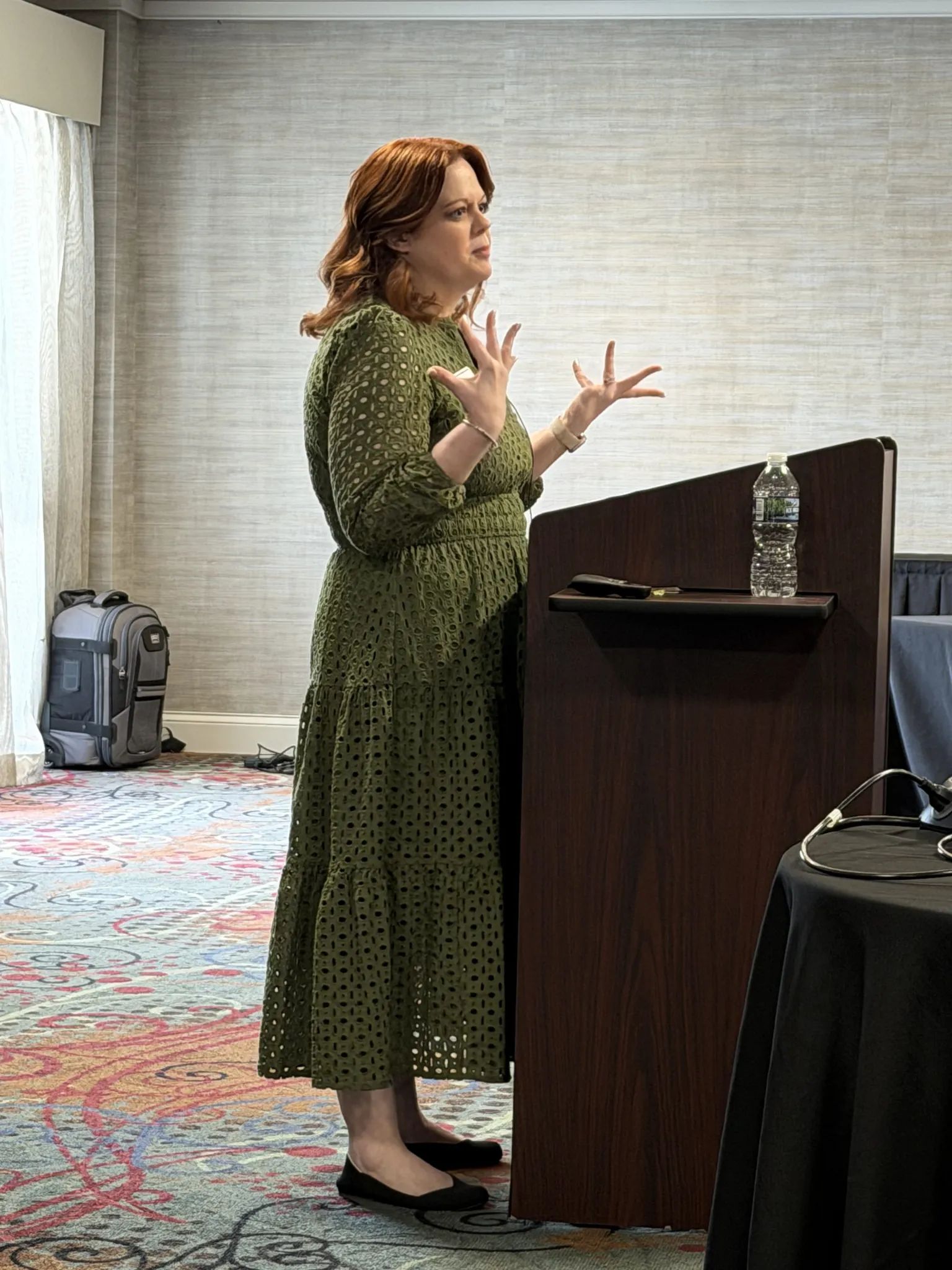
Dena Gillis – 1% Better Conference 2026
At the age of 16, carrying pain she didn’t have the tools or language to understand, she attempted to take her own life.
She told this heavy, heartfelt and powerful story quietly with no drama. Just the truth. When she quickly regretted it and ended up on a dirty bathroom floor at school begging classmates for help while they told her she was being dramatic and just over-reacting. Dena was rushed to the hospital. After being treated and sent home to parents who were, as she put it in one word, “embarrassed.” They actually told her they would never speak of it again. This was so hard to hear. I was choked up and teary eyed. I was feeling all the feels.
I want to sit here, on that for a just a minute. I think a lot of us have had those moments where the people who were supposed to show up for us, didn’t. It’s not because they were some kind of monster.But because they were operating from their own unprocessed pain and their own generational baggage. Sometimes it’s a father that had also survived an abusive household. Or a mother had been raised to keep up appearances and keep her opinions quiet. They were doing the best they knew how. But unfortunately, the best they knew how still left a mark. That part of her story isn’t a detour. It’s kinda like the whole foundation.
Resilience Is a Muscle, Not a Mindset Poster
Here’s the thing Dena said that I keep coming back to. She described resilience not as some inspirational catchphrase, but as a muscle. One that gets torn. Rebuilt. And strengthened over time. That tracks with literally everything I know about getting your finances or any part of your life together.
You don’t become financially resilient by reading one blog post or listening to one podcast episode and having a lightbulb moment. You build it by making mistakes, recovering from them, and doing something differently next time. You build it by getting hit with an unexpected expense and surviving it. By taking on too much debt and finding your way out. By maybe trusting the wrong financial product in the beginning, or the wrong advisor, or your own worst impulse purchases, and learning from it without completely falling apart.
Dena wasn’t talking about money. But she was absolutely talking about the same process. She lost her brother at the young age of 33. He died suddenly from an undetected heart defect. She said she was on the phone with her father, and then collapsed to the floor. In a single phone call, she went from little sister to only child. “There is no road map for that kind of grief,” she said. “No timeline. No checklist. No right way to mourn.”
Anyone who has ever had the ground fall out from under them, or the their world come crashing down around them knows exactly what she means. And the parallel to financial rock bottom is uncomfortably real. When you’re drowning in debt, when you’ve lost a job or a business, when you look at your bank account and feel that particular brand of shame and hopelessness, there’s no neat five-step plan that makes it okay immediately. Grief and financial devastation share a lot of the same emotional DNA. This unbearable weight that is just crushing us.
“There is no road map for that kind of grief,” she said. “No timeline. No checklist. No right way to mourn.”
Breaking the Cycle Is the Work
One of the most powerful threads running through Dena’s entire talk was this idea of breaking cycles. Her parents, for all their flaws, were trying to do better than the generation before them. They didn’t fully succeed. But Dena took that baton and ran with it in a completely different direction.
When she became a mother, she made a decision. The cycle of emotional unavailability was ending with her. She promised herself her daughter would never look out into a crowd of parents and not see her face. She told her she was proud of her. She showed up.
This is something I often reminded my foster daughter. I recall times when she would express that her mom ended up struggling, her brother ended up struggling, and she’d just follow and end up struggling too. Her cards were already dealt. I would remind her, she can break the cycle. The “bad luck” or poor decisions can end with her and she could change that family tree! This is financial independence work too. Not in some abstract metaphorical way. Literally.
So many of us are carrying financial habits we didn’t choose. Spending patterns, debt avoidance, fear of investing, impulse buying for emotional relief. These are the money scripts or beliefs that get passed down just like traits like eye color! The parents who never talked about money, or who fought constantly about money, or who treated credit cards like free money, shaped how we handle our own finances today. Breaking that cycle requires the same intentional, and yes, sometimes painful work.



Other Posts



Thanks again for following along! Keep those Horns Up, my friend 🤘 🤘 And please share this newsletter with those you think would find value!